
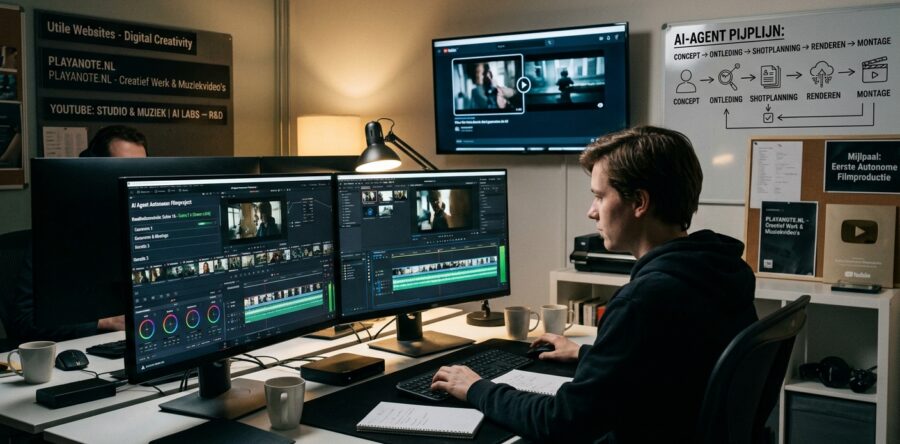
September 14, 2026, 06:30. These days, anyone can prompt a single five-second AI video. But telling a complete story with consistent characters, appropriate camera work, speech, music, and editing is a far more complex puzzle. Last night, we reached a huge milestone in our internal development work: our autonomous AI agent independently ran two complete video projects from concept to a edited film of nearly three minutes, without any human intervention.
The result is a rough version that we can then build upon using a hybrid approach: certainly not the perfect final film yet, but a fully-fledged working draft straight from a film concept.
From loose prompts to a self-correcting chain
The biggest bottleneck in AI video is context and quality control. Normally, faces change between shots, visual consistency is lacking, or a process stalls on a faulty render. Instead of tying separate tools together, we built a closed chain of specialized agents: from concept analysis and scene setup — viewed through the eyes of a director and editor — to shot planning and editing.
The decisive proof came last night in a scene that initially failed:
- The automated quality control gave a take a 6.5, below our standard of 7.0.
- Instead of stopping, the agent analyzed the deviation and adjusted the parameters itself.
- After a second attempt (6.7), the system forced a third iteration.
- The scene then achieved a 7.4 and only then received the green light to proceed to editing.
The autonomous night shift, human direction
For us, this does not mean that humans become redundant, but rather that the role changes. You can generate multiple drafts in a short amount of time, allowing you to find the right core of a film faster.
The final video edit remains human work. Otherwise, you quickly end up with similar, predictable edits. True editing is much more than gluing footage together with transitions: it is about timing, rhythm, emotion, silences, and musical breathing room.
The AI acts as a tireless night crew doing the heavy computational lifting, setting up the stage, and assembling a complete first cut. In the morning, as a creator, you step directly into the director's chair to artistically refine the story further.
Built locally through trial and error
An important detail: almost everything in this pipeline runs locally on our own systems. Only the central agent intelligence runs on DeepSeek V4. Developing these kinds of processes requires an enormous amount of experimentation and has already cost billions of tokens.
It is pure trial and error: by stumbling and getting back up, we move one step further every time.
For UtileWebsites, this shows where digital creativity is heading: the distance between an idea in your head and a tangible film prototype on your screen is smaller than ever.
Earlier creative hybrid work with our AI agent
This autonomous milestone is the next phase of a process we have been working on for a while. In hybrid collaboration with our AI agent, we previously developed various music videos and short films.
Check out this creative work on Playanote.nl. Films and music videos are already available there. Part of our work can also be viewed on our two YouTube channels:
Under the hood: from prompt editor to autonomous orchestration For the tech enthusiasts, some technical context: the core of this system is driven by the open-source agent OpenClaw, with DeepSeek V4 as the 'brain'. But a bare agent is nowhere without the right environment. The real innovation lies in the extensive, custom agentic scaffolding (the framework) we built around it.
We developed a complete ecosystem of proprietary tools in which this agent functions like a fish in water. An important detail: no external, traditional editing software is involved here. The agent itself analyzes the concept, calls the appropriate tools for the scenes, performs quality checks, and autonomously builds the timeline.
Nice to mention: the roots of this project lie in our Storyline-Prompt-Editor on GitHub. Although we have left that initial setup far behind us now, it was the conceptual starting point that led us to the complex, self-correcting tool-chain that successfully delivered these films last night.

