
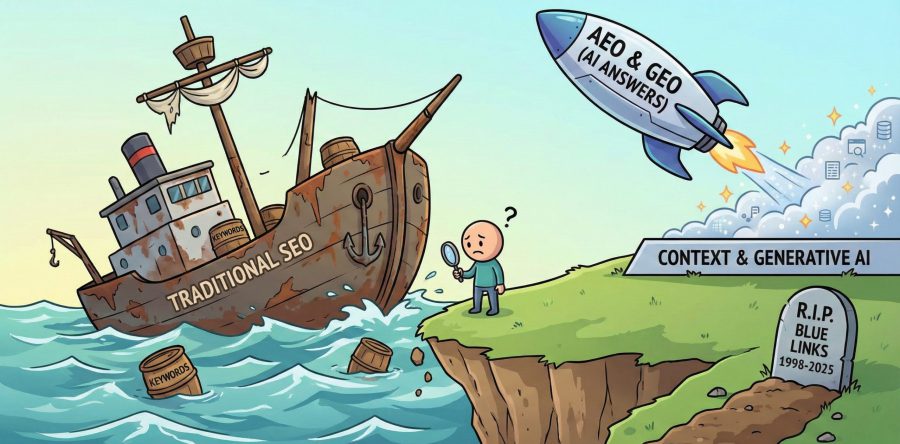
AEO is about winning the short term. The goal is to be the direct, factual answer to specific, transactional questions. Think of questions like: "What does a professional website cost?" or "How do I improve my conversion rate?".
The tactic for AEO:
- Direct questions in headings: Use H2 headings that literally state the questions your ideal customer is asking.
- The "Snippet" rule: Directly under the heading, give a concise and clear answer in 2 to 4 sentences. This is what AI bots scan for their direct answers.
- Schema Markup: Use technical Schema code (such as FAQ and How-to tags) so that AI bots can understand your data directly and index it without having to "read" the entire page.
What is GEO (Generative Engine Optimization)?
GEO is the strategy for the long term and for authority. It is not about "ranking high" in a list, but about becoming the trusted source that is cited and summarized by AI models (such as Gemini and GPT-4) in their answers and narratives.
When an AI generates a complex answer about your industry, you want your data, your research and your vision to be used as a reference.
The tactic for GEO:
- Unique data and original research: AI models are trained on general knowledge. They are hungry for original insights and statistics that cannot be found anywhere else.
- E-E-A-T (Expertise & Authority): Optimize your author bios. The AI must be able to verify why you are an expert in your field.
- Depth of content: Write long-form content that fully explores complex topics. Support your claims with citations from experts and external sources to increase your own credibility.
The Power of the Combination
It is not a choice between AEO or GEO; you need both to remain relevant in 2026.
- Use AEO for your product pages, pricing and practical frequently asked questions (high purchase intent).
- Use GEO for your whitepapers, in-depth blogs and trend reports (thought leadership and brand preference).
The Urgency of Now
We are currently in a critical window. By the end of this year, an estimated 40% to 60% of all searches will end without a click to a website. AI models are now actively learning which sources they can trust.
Companies that start building this "AI authority" now are creating a foundation that competitors will find difficult to break through later. Once an AI recognizes you as the specialist, you become the default in every generated answer.
Conclusion: Stop blindly chasing clicks, and start building a platform that AI cannot ignore.
From Public Visibility to Internal Intelligence: RAG & LangChain
What AEO and GEO do for your public visibility (how AI models understand and cite your website), RAG (Retrieval-Augmented Generation) does for your internal business intelligence.
What is RAG?
RAG is a technique where an AI model (such as GPT-4) does not only answer based on its training, but first retrieves relevant information from your own data sources (documents, knowledge bases, CRM, ERP) and then uses that information to generate an accurate, contextual answer.
In practice:
An employee asks a question to an internal AI assistant.
The assistant searches in your own documentation, project history or product catalog.
The answer is not "generic", but based on your unique business data.
The role of LangChain
LangChain is a framework that makes building RAG systems easier. It offers:
Document loaders (PDF, Word, databases, APIs)
Vector stores (to make text searchable for AI)
Chains (workflows that combine retrieval + generation)
Agents (AI that independently decides which data it needs)
With LangChain you can, for example:
Build an internal chatbot that answers based on your support tickets and manuals.
Create a customer portal where AI automatically gives product advice based on previous orders and stock.
Create a knowledge base assistant that helps employees with complex processes without them having to search through dozens of documents.
The same technique that makes your website "AI-ready" (structured data, clear answers, unique insights) is the technique that makes your internal systems smarter.
